Methylamine is a weak base. The hydrolysis equation is:
The base, CH3NH2, abstracts a proton from water. The conjugate acid is CH3NH3+. This is a basic solution because hydroxide ion is produced. The base hydrolysis constant for this reaction, Kb is:
The base hydrolyis constant can either be looked up or determined from Ka. The value of Ka for CH3NH3+ is 2.3 x 10⁻¹¹.
Here, we will relate Ka, Kb, and Kw. Consider the following equations:
A– (aq) + H2O (l) ⇄ HA (aq) + OH– (aq) \(\displaystyle K_b\;=\;\frac{[HA][OH^-]}{[A^-]}\)
Sum the equations:
A– (aq) + H2O (l) ⇄ HA (aq) + OH– (aq) \(\displaystyle K_b\;=\;\frac{[HA][OH^-]}{[A^-]}\)
___________________________________________________________________________
2 H2O (l) ⇄ H3O+ (aq) + OH– (aq) Ka x Kb = Kw
We see that Ka x Kb = Kw = 1.0 x 10⁻¹⁴
If Ka is known, we can find Kb. If Kb is known, we can find Ka.
For example acetic acid has Ka equal to 1.8 x 10⁻⁵. We can calculate Kb
Weak bases will undergo hydrolysis with water to produce the conjugate acid and hydroxide ion. For example, fluoride ion will react with water to produce hydrofluoric acid and hydroxide ion.
Let’s calculate the pH of a solution that is 0.25 M CH3NH2. Kb = 4.4 x 10⁻⁴.
First write the hydrolysis reaction.
CH3NH2 (aq) + H2O (l) ⇄ CH3NH3+ (aq) + OH– (aq) \( K_b=\frac{[\mathrm{CH_3NH_3^+}][\mathrm{OH^-}]}{[\mathrm{CH_3NH_2}]}=4.4\times 10^{-4}\)
Set up an ICE table.
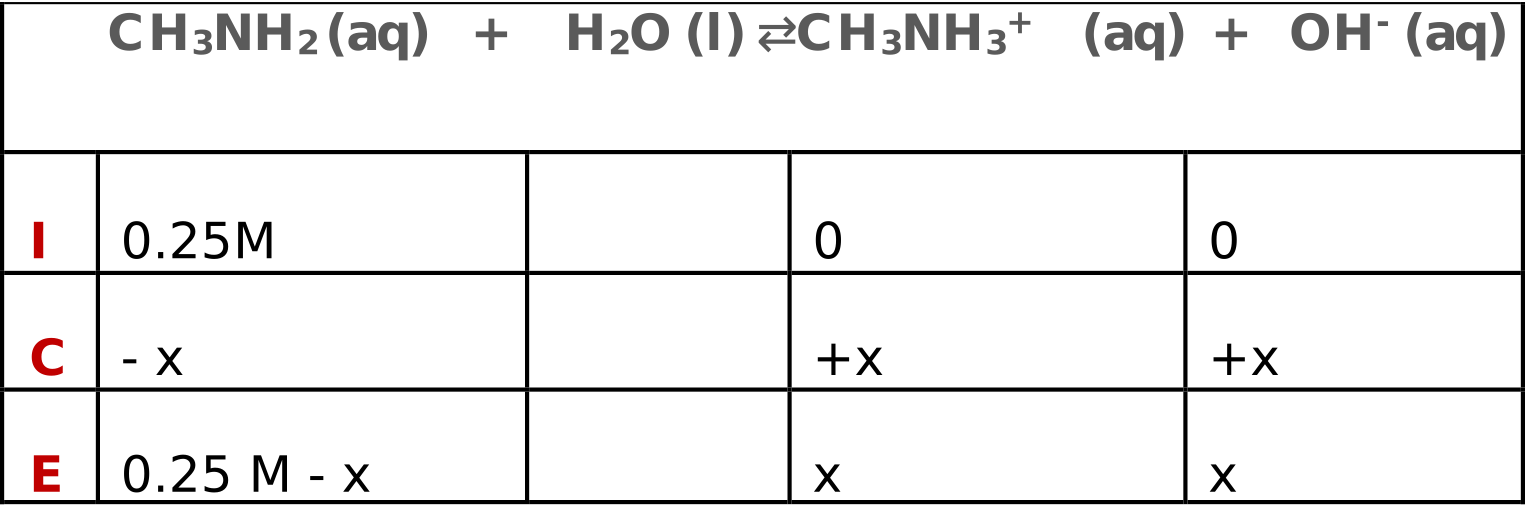
Assume x is neglible and 0.25 M – x ≅ 0.25 M
\(\displaystyle \frac{x^2}{0.25}\;=\;1.5\times 10^{-11}\)
Solve for x.
\(\displaystyle x\;=\;\sqrt{0.25\times\;(1.5\times 10^{-11})}\;=\;1.9\times\;10^{-6}\;M\)
Check assumption.
\(\displaystyle \frac{1.9\times 10^{-6}\;M}{0.25\;M}\times\;100\;=\;0.00076\%\)
The assumption is valid.
The [OH–] = 1.9 x 10⁻⁶ M. Use pOH to calculate the pH.
pH = 14.00 – (-log(1.9 x 10⁻⁶) = 8.28
The solution is basic as we expected.
Watch the following video.
Exercises
Exercise 1. Calculate Kb for NH3 if Ka for NH4+ is equal to 5.6 x 10⁻¹⁰.
Exercise 2. Write a balanced net ionic equation and the equilibrium constant expression for the weak base ethlyamine, C2H5NH2, in water. Ka (C2H5NH3+) = 8.6 x 10⁻⁴.
Exercise 3. Pyridine is a base with Kb = 2.0 x 10⁻⁹. What is the pH of a 0.75 M pyridine solution?
Exercise 4. Ammonia, NH3 has a Kb = 1.8 x 10⁻⁵. What is the pH of an aqueous solution that is 0.35 M NH3?
Exercise 5. A 0.75 M aqueous solution of methylamine, CH3NH2, has a pH of 12.26. Calculate Kb and the equilibrium concentrations of [CH3NH2], [CH3NH3+], and [OH–].
Back to Acids and Bases: Aqueous Equilibria
Back to Study Guides for General Chemistry 2